Tuesday, 16 May 2023

Sudan in meltdown

 Published in the Jerusalem Post, 16 May 2023

On May 6 delegates from the two military groups slogging it out for control of Sudan met for pre-negotiation talks in Jeddah, each side represented by a three-person team.  The discussions are being masterminded by the US and Saudi Arabia, who began by urging the combatants to agree to an effective short-term ceasefire while the talks take place.  That exhortation has so far fallen on deaf ears, but both teams agreed that they bear a heavy responsibility to help alleviate the suffering of the Sudanese people, including the urgent need to reach agreement on delivering emergency aid.

On May 12 the BBC reported that the warring factions had signed an accord to protect civilians and admit badly needed humanitarian assistance. They are still discussing a proposal for a truce and a mechanism to monitor it.
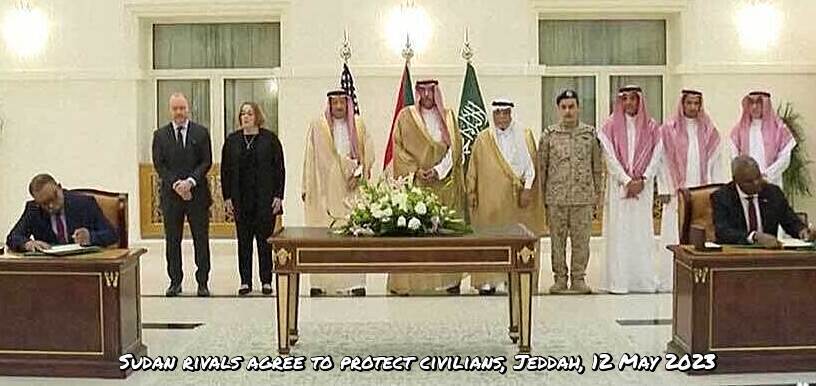
Although formally the two sides are the Sudanese Armed Forces (SAF) and the Rapid Support Forces (RSF), in effect they are the respective leaders - Abdel Fattah al-Burhan, the de facto ruler of Sudan, and his rival, Mohamed Hamdan Dagalo, better known as "Hemeti", who is still nominally Burhan’s deputy on the ruling Council.

Army chief Burhan will insist that he represents the legitimate government which Hemeti is seeking to overthrow.  Hemeti will demand equal status for the two sides.  Since his paramilitary RSF fighters control much of Khartoum, he will want a freeze on the current military position.  Burhan will want a return to the positions before the clashes began.

As for the political issues that will need to be addressed, each will demand an agenda that suits their interests.  There is one matter on which Burhan and Hemeti agree -­ neither wants the sort of democratic government that has been the nation’s objective ever since the overthrow of Sudan’s dictator, Omar al-Bashir, on April 4, 2019.  Even so, national and international pressure may force both to go along with the goal of a fully democratic state based on free and fair elections.

“Though the mills of God grind slowly,” wrote the American poet Longfellow, “yet they grind exceeding small.”  It took a full 30 years for Bashir to receive just retribution for the excesses of his regime, but in the end it came.

            Back in June 1989 Bashir headed a military coup in Sudan.  Ousting the previous regime, he assumed full executive and legislative powers, declared himself president and established a dictatorship.  For 30 years he held Sudan in an iron grip.

Bashir’s rule came to an end in April 2019, when widespread popular uprisings precipitated a coup by the army.  The Forces for Freedom and Change (FFC), an umbrella group agitating for complete change in Sudan, were determined that this uprising would not be hijacked by another military junta.  So a Transitional Military Council was set up in August 2019 to help the country move to democracy.  The Council appointed Abdalla Hamdok as prime mininster.

Few politicians in modern times have experienced such a see-saw of events.  He was appointed in August 2019, but despite the FFC’s best intentions there was indeed a coup in October 2021 led by army chief Burhan.  Hamdok was deposed and arrested.  Intensive negotiations between the FFC and the military followed.  An agreement of sorts was concluded, and on November 21 Hamdok was reinstated as prime minister.  The following March he survived an assassination attempt.  On January 2, 2022, he resigned.  He remains a potent factor, though, on the political scene.

The agreement between the Sudanese military, led by Burhan, and the FFC led to the  establishment of a new transitional administration. Its declared intention was to lead the country toward a democratic and civilian government, but in reality it was dominated by Burhan, who became the effective leader of the country. 

What followed was economic instability and political unrest, and it was not long before armed militia troops headed by Hemeti began attacking SAF forces.  Soon the two armed groups were engaged in a vicious civil war.  

Sudan, of course, is nominally one of Israel’s new Arab partners under the Abraham Accords.  Where does this chaotic state of affairs leave its normalization deal with Israel?

Shortly after the overthrow of the Bashir regime in April 2019, the US and the United Arab Emirates (UAE) brokered contacts between Israel and Sudan’s transitional administration dominated by Burhan.  He and his military supporters wanted to distance themselves from the old Bashir regime, which had hosted Hamas and Islamic jihad, and had allowed Sudan to become an open conduit for weapons and supplies passing to Hamas in the Gaza Strip.  So Burhan and his supporters seized the chance to join the new regional order that was emerging, predicated on opposition to Iran and a working partnership with Israel.

It was in February 2020 that Israel’s then-prime minister, Benjamin Netanyahu, met Burhan, head of Sudan’s Sovereignty Council, in Uganda, where they agreed to normalize the ties between the two countries. An initial agreement on October 23, 2020 saw Sudan removed from the US government list of countries promoting terrorism, and on January 6, 2021 in a quiet ceremony in Khartoum, Sudan formally signed up to the Abraham Accords.

Just how substantive is the Israel-Sudan normalization deal? Whatever the outcome of the conflict between Burhan and Hemeti, Sudan is a nation in transition, on the road to parliamentary elections intended to usher in full democratic civilian rule.  The then military leadership that concluded the normalization deal with Israel was acting perfectly legitimately on behalf of the state of Sudan.  A democratic government, once in power, could doubtless either endorse or renounce it.  Which way will the chips fall?

Published in the Jerusalem Post, and in the Jerusalem Post on-line as "Which way will the chips fall while Sudan is in meltdown?" on 16 May 2023:
https://www.jpost.com/opinion/article-743150

Published in Eurasia Review, 20 May 2023:
https://www.eurasiareview.com/20052023-sudan-in-meltdown-oped/

Published in the MPC Journal, 18 May 2023:
https://mpc-journal.org/sudan-in-meltdown/

Published in Jewish Business News, 18 May 2023:
https://jewishbusinessnews.com/2023/05/18/sudan-in-chaos/

Wednesday, 10 May 2023

Cementing ties with Iran's neighbours


          On 19 and 20 April Israel’s foreign minister, Eli Cohen, visited two of Iran’s close neighbours in central Asia.  Facing each other across the Caspian Sea are Azerbaijan, which borders north-western Iran, and Turkmenistan, which borders its north-east.  Both were among the fifteen republics once swallowed up by the USSR, and both regained their independence in 1991. 

Subsequently both avoided falling under the domination of their increasingly powerful neighbour, Iran. For that reason they became of great strategic importance to Israel, which has taken pains to maintain good relations with them. 

Cohen went first to Azerbaijan.  Israel has had a close strategic and business partnership with the Azeris for more than thirty years, but not a diplomatic one. That deficiency was remedied less than a month before Cohen’s visit, when Azerbaijan opened its embassy in Israel – the first ever of a Shi’ite Muslim nation.  Up till then Azeri-Israeli diplomatic relations had been a somewhat one-sided affair.  Israel, which was one of the first countries in the world to recognize Azerbaijan’s independence in December 1991, actually established its own embassy in the capital, Baku, back in 1993.  A whole range of political and practical difficulties had frustrated Azerbaijan’s reciprocal gesture, until this March.

Israel supported Azerbaijan with increased shipments of weapons during the 2020 Second Nagorno-Karabakh War with Armenia.  Partly because of this, Azerbaijan emerged victorious from the six-week conflict and regained control over long-disputed territories. 

“Israel showed we were there with Azerbaijan at a time of need,” said Israel’s ambassador to Azerbaijan, George Deek.  “For them, it was proof of a real friendship.”

Even though commercial ties between the two countries are strong (Israel imports 30% of its oil from Azerbaijan, while Azerbaijan acquires nearly 70% of its arms from Israel), Cohen declared that the opening of the Azeri embassy in Tel Aviv symbolized a new era in relations between the two countries. On his visit to Azerbaijan Cohen was accompanied by a 20-strong delegation representing the Israeli cyber, defence, homeland security, water management, and agriculture industries. The delegation met with Azeri business and government leaders, and discussions ranged widely and included Azerbaijan’s desire to expand Israeli imports to include the cyber and solar energy fields. The two sides also agreed to cooperate on space exploration.

Underlying the close business and working relationship, of course, lies the threat posed to the region by Iran.  When meeting Azerbaijan’s foreign minister, Jeyhun Bayramov, Cohen spoke about the dangers. “Israel and Azerbaijan share the same perception of the Iranian threats,” he said. “The Iranian ayatollah regime threatens our regions, finances terrorism and destabilizes the entire Middle East.”

Media reports suggest that the Azeris have been allowing Israel to launch reconnaissance missions into Iran from its territory.  More than this, some reports speculate that any future Israeli strike on the Iranian nuclear programme could enjoy the same privilege.

From Azerbaijan Cohen flew to Turkmenistan, becoming the first Israeli foreign minister in 30 years to do so.  He met President Serdar Berdimuhamedov, and opened Israel’s first permanent embassy in the capital, Ashgabat.  Israel and Turkmenistan established diplomatic relations back in 1993, but it was only some ten years ago that Israel sent its ambassador to the country, and he has been operating out of temporary premises ever since.  

"Turkmenistan is an…energy powerhouse in a strategic location," said Cohen. "The opening of our permanent embassy today strengthens the relationship between the two countries."

The event was also of symbolic significance.  Located a mere 15 kilometres from the Iranian border, the new embassy is the closest to the Islamic Republic of any Israeli diplomatic mission. It sends a message to Iran’s leaders that Israel is a present and growing influence in the region.  The importance of the occasion was recognized by other states concerned by the threat posed by Iran, and ambassadors from a number, including the US, Azerbaijan and the United Arab Emirates attended the opening ceremony. 

Cohen was joined at the event by his Turkmen counterpart, Rashid Meredov.  The two cut the ribbon together.  “We have a very good relationship with the State of Israel,” said Meredov.  “We will do everything toward expanding and strengthening our relationship…”

A topic common to Cohen’s discussions with both Azerbaijan and Turkmenistan was the prospect of connecting Israel’s natural gas deposits to their pipelines, thus increasing the potential for delivering Israeli gas to Europe.

Another possibility would involve Turkey, which enjoys close linguistic, cultural and political ties with the Central Asian states.  With Europe eager to divest from Russian energy, Turkey has become a potential gateway through which the continent could be supplied with oil and natural gas from alternative sources, including both Israel and Central Asian states.

Azerbaijan and Turkmenistan are very different in nature.  Azerbaijan is a secular democratic republic headed by a president – since 2003, Ilham Aliyev. Its constitution promises its citizens “full civil and political rights, regardless of ethnic origin, religion, class, profession, or sex”.  The thriving Jewish community, one of the largest in the Muslim world – up to 18 thousand – enjoys complete freedom of religion and worship.

Turkmenistan, on the other hand, is a closed society with an authoritarian political system and centralized economy. The country’s gross domestic product is heavily dependent on the export of natural gas, but the nation’s massive revenues are not reflected in the lifestyle of most Turkmen.  The official US government website maintains that corruption is rife within virtually all layers of society in Turkmenistan, while the government’s overall human rights record remains poor, including its restrictions on religious freedom.

           Despite the differences between Azerbaijan and Turkmenistan, Israel has always understood the political importance of maintaining close relations with both.  As regional peace and stability are increasingly threatened by Iran, it becomes more important than ever for Israel to improve and develop existing ties with the two states. Ideas to do so are already afloat.  Turkmenistan’s President Berdimuhamedov has said he is considering following Azerbaijan and opening a Turkmenistan embassy in Israel, while Israel’s President Isaac Herzog has said he intends to visit Azerbaijan later this year.

Published in the Jerusalem Post, 9 May 2023:
https://www.jpost.com/opinion/article-742442

Published in Eurasia Review, 12 May 2023:
https://www.eurasiareview.com/12052023-cementing-ties-with-irans-neighbors-oped/

Published in the MPC Journal, 12 May 2023
https://mpc-journal.org/cementing-ties-with-irans-neighbours/

Published in Jewish Business News as "Building bridges with Iran's neighbors", 11 May 2023:
https://jewishbusinessnews.com/2023/05/11/building-bridges-with-irans-neighbors/

Tuesday, 2 May 2023

Lebanon is in trouble

            Lebanon is in the midst of a long-standing political impasse.  It has a caretaker government and no head of state.  In addition, its economy is close to collapse, while a corrupt political class is clinging to the power and influence it has exercised for generations.  On top of all that, a financial scandal that had been simmering away for months has suddenly boiled over. A judicial delegation from France, Germany and Luxembourg are investigating accusations against the Governor of Lebanon’s central bank, Riad Salameh, who is accused of embezzling bank assets, money laundering and mismanaging public funds. On April 25, on the delegation’s third visit to the country, Lebanese judicial authorities agreed to cooperate with them.

            It was in July 2020 that a group of Lebanese lawyers launched a formal accusation against Riad Salameh and his brother Raja of allegedly defrauding the central bank of more than $300 million (over NIS 1,000,000,000).  The 72-year-old governor is accused of charging bond buyers a commission, described as a fee, and transferring the funds to a company owned by Raja which then laundered them across at least five European countries.  Both Salameh brothers deny wrongdoing.

            The European delegation had returned to Lebanon to interrogate suspects and witnesses.  On April 25 Raja, the governor’s brother, claiming to be ill, failed to attend a scheduled hearing. It was this that apparently led Lebanese judicial officials and the European delegation to agree to amalgamate their separate investigations.

Reporting the affair, Reuters say that French court documents indicate that money from Raja’s company was used to make numerous real estate purchases across Europe and the UK.  The Salameh brothers and an assistant, Marianne Houayek, have been charged with financial crimes in two separate cases in Lebanon, but have not yet been formally charged in the investigating European countries.

This financial scandal can only strengthen the persistent public accusations of corruption at the highest levels of Lebanese public life.  With Hezbollah a major force in Lebanon’s political structure, they are scarcely surprising.  For example, there continues to be no substantive progress in the inquiry into responsibility for the August 4, 2020 Beirut port explosion.  Hezbollah and Hezbollah-allied individuals were fingered early in the investigation, but have been successful so far in blocking it.

The first investigating judge, who soon had named individuals in his sights, was removed, to be replaced by judge Tarek Bitar in February 2021.  Like his predecessor, he was immediately faced with a series of legal challenges and complaints filed by some of the officials he intended to question.  As a result, the investigation was suspended in December 2021.  On January 23, 2023 Bitar attempted to restart the inquiry, and issued charges against current and former senior officials, including the public prosecutor at the Court of Cassation, Ghassan Oueidat.

On January 25, Oueidat imposed a travel ban on Bitar and charged him with “rebelling against the judiciary, and usurping power”.  In early February, Bitar postponed the hearings he had scheduled for that month, reportedly until the dispute with Oueidat was resolved. In response to these developments, Amnesty International and Human Rights Watch repeated previous calls for the Human Rights Council (HRC) to establish an impartial international fact-finding mission into the port explosion.

            Meanwhile nothing is being done to tackle Lebanon’s crumbling economy.  The International Monetary Fund has offered a $3 billion bailout package, conditional on a host of structural and financial changes. But with the country lacking both a president and a fully empowered Cabinet, no progress has been made on reforms that could help remedy the situation.  Without a political solution on the horizon, the Lebanese pound continues to depreciate ­– and with it the salaries and pensions of the country’s security personnel, public sector workers and military. On March 22, hundreds of soldiers and army pensioners mounted an unprecedented protest outside the prime minister’s headquarters.

   The political impasse seems equally insoluble. Lebanon has had no effective government since Hassan Diab resigned as prime minister in August 2020, days after Beirut’s massive blast.  It has had no head of state since President Michel Aoun’s term ended on October 31, 2022.  The country is being run by way of a caretaker administration headed by Najib Mikati, Lebanon's richest man.  He was appointed prime minister by Aoun in September 2021, as the country struggled with a collapsing economy and the failure to achieve political reform.

One reason for Lebanon’s political crisis is that Hezbollah has infiltrated deep into Lebanon’s body politic and its administrative structure.  Acting at the behest of its Iranian sponsors, Hezbollah’s influence on Lebanon has been, and remains, dire. One prime example is how it involved Lebanon in the Syrian civil war in support of Iran’s Islamic Revolutionary Guard Corps (IRGC). Upholding Bashar al-Assad’s regime was in Iran’s interest, never in Lebanon’s, yet its young men fought and died there.

 Hezbollah is key to frustrating any agreement on Aoun’s replacement as president.  Hezbollah and the Amal Movement party, which together constitute Lebanon’s Shia base,  support politician Sleiman Frangieh. Despite Hezbollah’s best efforts on his behalf, vehement opposition from the majority of the country’s Christian, Sunni and Druze political blocs has left Frangieh short of the 65 votes required to be elected.  Frangieh, whose grandfather served as president in the 1970s, is heir to an old Lebanese Christian political dynasty and a friend of Syria’s Assad.

Lebanon is without a proper government because it is without a president.  After the parliamentary elections in May 2022, prime minister Mikati failed to form an administration that met with President Aoun’s approval, a constitutional requirement.  When Aoun’s own franchise ran out without a resolution, the existing government went into caretaker mode.

A fair number of outside interests are trying to devise ways of extricating the country from its most pressing difficulties. Yet to succeed the impetus for change and reform must come from Lebanon itself. Somehow the power and self-interest of the old establishment has to be overcome.

Published in the Jerusalem Post, 2 May 2023:
https://www.jpost.com/opinion/article-741796

Published in Eurasia Review, 9 May 2023:
https://www.eurasiareview.com/08052023-lebanon-is-in-trouble-oped/

Published in the MPC Journal, 10 May 2023
https://mpc-journal.org/lebanon-is-in-trouble/

Published in Jewish Business News as "Troubled Lebanon", 4 May 2023
https://jewishbusinessnews.com/2023/05/04/troubled-lebanon/

Thursday, 27 April 2023

Erdogan fights to retain power

Published in the Jerusalem Post, 27 April 2023


Recent events have not been playing to the advantage of Turkey’s president, Recep Tayyip Erdogan, and there seems a real chance that he and his AK party may not emerge victorious from the presidential and parliamentary elections scheduled for May 14. 

Erdogan certainly hopes to be re-elected, if only to preside over the celebrations marking the 100th anniversary of the Republic of Turkey, which take place later this year.  Modern Turkey came into existence on October 29, 1923 under its first president, Mustafa Kemal. His great achievement was to replace the creaky, autocratic, religion-based rule of the Ottoman past with a secular westernized form of administration.  He was later formally endowed by parliament with the title Ataturk, Father of the Turks. 

For the past twenty years the country has been ruled by Erdogan, first as prime minister and from 2014 as president.  Erdogan, a strong adherent of the Muslim Brotherhood, has spent much of his time attempting to reverse some of Ataturk’s achievement. Exhibiting authoritarian tendencies from the start, Erdogan’s rule has degenerated into something approaching autocracy – a development accelerated after the anti-government coup of July 2016, some aspects of which remain unclear.

Having jailed thousands of political opponents, journalists and leading public figures, Erdogan has also systematically restricted impartial coverage of national and international events by the media.  According to Reporters Without Borders (RSF), about 90 per cent of Turkey's national media is now under government control.  In March the government refused to renew the broadcasting licence of the German media outlet Deutsche Welle.

Even so, Erdogan’s power is still subject to certain restrictions.  Much to their credit, those operating Turkey’s electoral system have succeeded in remaining largely independent of government interference.  Operating under close supervision, the electoral process in Turkey has managed to stay relatively free and fair.

Erdogan and his party have fallen in the public’s estimation for a number of reasons.  After the violent earthquakes of February 6 left millions of Turks homeless, both president and ruling party were widely criticized for their long-term failure to reform the country’s building regulations in advance of the disaster.  They were also condemned for mishandling the search and rescue efforts afterwards, while questions have been asked about how precisely the huge sums raised by a so-called earthquake tax imposed since 2002 (approximately $4.7 billion in total), have been disposed of.

Inflation in Turkey, out of control for a long time, officially stood in March at just above 50%, which is bad enough, but financial experts are saying the true rate is over 100%.   Starting in early 2021 the Turkish lira began to fall sharply in value.  By January 2022 the currency had lost 83% of its value, and the decline continued.  Over the year to February 2023, it had lost a further 40% against the American dollar. 

It has steadied in recent months, as has the rate of inflation, but the extended cost-of-living crisis has gripped all Turkish households and squeezed earnings and savings.  This is why Erdogan launched his re-election campaign with a party pledge to slash inflation to single digits and boost economic growth.

Erdogan’s main opponent in the presidential poll is Kemal Kilicdaroglu.  Unlike previous presidential elections when Erdogan faced a disunited opposition, Kilicdaroglu is fighting as a unity candidate for six opposition parties.  He also has the unofficial backing of Turkey's pro-Kurdish HDP which, because of a court case alleging links to Kurdish militants, is running for parliament under the banner of another party, the Green Left.

 Kilicdaroglu’s Nation's Alliance, also known as the Table of Six, is united in its desire to return Turkey from the presidential system created under Erdogan to one led by parliament. To change the system, they need to win 400 of Turkey's 600 MPs or, to take a proposal to a referendum, at least 360.  As for the presidential election, any candidate that can secure more than half the vote is the outright winner. Failing that, the race goes to a run-off two weeks later. In that event whichever party had won the parliamentary vote would be best placed to gain the presidency.

Kilicdaroglu’s chances of winning the election outright in the first round may have been dented by the decision of a former center-left party colleague, Muharrem Ince, to join the presidential race.  Ince runs the secular nationalist Homeland Party and has a strong presence on social media.  Young voters in particular are said to have been impressed by his dance moves on TikTok.

Pre-election polls are notoriously unreliable.  Recent surveys published online, though lacking information about the numbers polled or the methods employed, all show Kilicdaroglu leading Erdogan.  The results of a poll published on April 14 showed Kilicdaroglu with 50.3% as against Erdogan’s 43.8%.  A poll by the organization Politpro published on April 22 gave Kilicdaroglu 47.7% and Erdogan 43%.  If these figures really indicate the nation’s voting intentions, then Kilicdaroglu stands a chance of winning the presidency in the first round. 

That leaves open the question of whether, if Erdogan were to lose, he would agree to a peaceful transfer of power.  In 2019, when his party lost the municipal election in Istanbul, he insisted on a re-run, only to be shocked when the voters not only re-elected the original winner, Ekrem Imamoglu, but by a much larger margin.  Imamoglu will not be participating in the forthcoming presidential poll. Found guilty of insulting public officials, he was sentenced last December to 31 months in jail and barred from all political activity.  Yet according to a very recent report in Le Monde he is not languishing in some prison cell, but has been criss-crossing the country for weeks receiving a rapturous reception.  The paper did not divulge how he has evaded incarceration.

Public opinion polls add to the excitement, but the only votes that count are the ones at the ballot box. There are several weeks yet before the elections and, as the saying goes, a week is a very long time in politics.

Published in the Jerusalem Post, and in the Jerusalem Post online titled: "Turkish Elections: Will Erdogan hold onto power?", 27 April 2023:
https://www.jpost.com/opinion/article-741329

Published in Eurasia Review, 29 April 2023:
https://www.eurasiareview.com/29042023-erdogan-fights-to-retain-power-oped/

Published in the MPC Journal, 1 May 2023:
https://mpc-journal.org/erdogan-fights-to-retain-power/

Published in Jewish Business News, 29 April 2023:
https://jewishbusinessnews.com/2023/04/29/erdogan-struggles-to-maintain-control/


Thursday, 20 April 2023

The Arab world prepares to readmit Assad

Published in the Jerusalem Post, 20 April 2023

 Assad visiting UAE in March 2023 is greeted by President Sheikh Mohammed bin Zayed al Nahyan

          Nothing succeeds like success. Despite every prediction to the contrary, Syria’s president, Bashar al-Assad, was not swept away during the Arab Spring but, with the considerable support of Russia and Iran, has clung to power.  In an utterly ruthless, no-holds-barred civil war, which included the use of deadly chemical weapons against his own people, Assad gained, and now maintains, control over some 70% of sovereign Syria.  in the process some 7 million Syrians have fled the country, while another 7 million are displaced. Even so, the Assad regime, ostracized by the Arab world since 2011 but having survived, seems to be edging its way back into acceptance. 

November 12, 2011 was the day the Arab League, appalled by the brutality of the Assad government’s reaction to the popular protests of the Arab Spring, suspended Syria’s membership and imposed sanctions. Shortly afterwards, as civil war erupted, the US and Europe added their own stringent sanctions on the Syrian government, and on companies connected to the Assad family in particular. 

Open disunity within the Arab family was not to the liking of several nation states, and efforts to rehabilitate Assad and his regime began as far back as 2018, when the United Arab Emirates (UAE) and Bahrain reopened their embassies in Damascus. In 2020 Oman took the further step of becoming the first Gulf state to reinstate its ambassador to Syria. 

More recently Jordan has been taking the initiative. Foreign Minister Ayman Safadi has said he aims to find an Arab solution to the overwhelming political, military, economic and humanitarian crisis that besets Syria, but in full coordination with the UN.   The initiative aims to launch Arab efforts to engage in dialogue with the Syrian government to resolve the crisis and address its humanitarian, security, and political problems.   “Jordan will present the initiative to Arab countries,” one source is reported to have said, “which will, in turn, set their conditions for restoring diplomatic relations with Syria.”

On March 25 Qatar, which has rejected previous calls to reinstate Syria to the Arab League, announced its support for the Jordanian initiative. In close coordination with the UAE and Egypt, Jordan hopes to achieve consensus on the initiative ahead of the Arab League summit in Riyadh on May 19.

As is not unusual in politics, it was an entirely extraneous event that gave the rehabilitation process an unexpected impetus.  The deadly earthquakes of February 6, which killed some 6,000 people in Syria, provided the opportunity for a number of Arab states to re-engage with Assad while contributing disaster relief. The diplomatic floodgates opened.  The UAE took the opportunity to normalize relations with Damascus, while in the aftermath of the quake Assad received the foreign ministers of the UAE, Jordan, and Egypt on separate occasions.  On March 19, Assad paid a state visit to Abu Dhabi, the second in two years, and met with UAE’s President Sheikh Mohammed bin Zayed Al Nahyan. 

On April 1, Syria’s Foreign Minister Faisal Mekdad arrived in Cairo to talk with his Egyptian counterpart, Sameh Shoukry, amid reports that a summit meeting between Egypt‘s President Abdel Fattah el-Sisi and Assad was being prepared.  Sources in Jordan confirmed that a similar meeting between King Abdullah and Assad was also being considered.

A further boost toward reconciliation followed the rapprochement in March between Saudi Arabia and Iran, Assad's main backer.  Now rumors are widespread that Saudi Arabia, which once supplied arms to the rebels seeking to oust Assad, will invite him to the Arab League summit it will be hosting in May. Lifting his suspension would seal Assad’s rehabilitation in the Arab world. 

            This would not please the US, which for a dozen years has held firm to its mantra “Assad must go.”  On the other hand, some softening of its hard line has been detected of late.

In March, Assistant Secretary of State for Near Eastern Affairs, Barbara Leaf, reiterated that Washington opposes any normalization of the Syrian regime without serious progress toward UN Security Council Resolution 2254, which in 2015 laid out a roadmap for a political settlement to end the crisis.  That Resolution called for negotiations between the government and those fighting it, free and fair elections, and the drafting of a new constitution.

None of that has taken place.  According to the current constitution no president may serve more than two consecutive 7-year terms.  In 2021 Assad was sworn in for his fourth term, following a presidential election procedure in which he claims to have won some 95% of the vote.

            However, Leaf went so far as to suggest that if Arab states did engage with Assad, it should involve a quid pro quo in terms of Assad moving toward Resolution 2254.  “What we are reading from what the Americans are saying,” an Arab diplomat commented, ”is ‘we are not against the initiatives you are doing …Let the Arabs try, and let us see what the results are’.” 

            Leaf was, however, skeptical of the claim by some states that re-engaging with Assad could detach Syria from Iran, whose militias helped turn the tide of the 12-year civil war in Assad’s favor.  Yet, according to a report in the Wall Street Journal, Arab nations in talks with Assad are offering him a deal that would restore ties between Syria and much of the Middle East while potentially curbing the influence of Iran. They are proposing aid worth billions of dollars to help rebuild Syria after the country’s 12-year civil war, and have pledged to lobby the US and European powers to lift sanctions on Assad’s government.  In exchange, Assad would engage with the Syrian political opposition, accept Arab troops to protect returning refugees, crack down on illicit drug smuggling and ask Iran to stop expanding its footprint in the nation. 

Whether Assad can be prized away from Iran is an open question. There must certainly be considerable attraction in the prospect of being accepted again within the Arab family – Iran, of course, is not an Arab nation. The question is how close toward the conditions of UN Resolution 2254 Assad feels able to move while not forfeiting his grasp on power. 

One acid test of whether real change is afoot will be whether Assad is offered a seat at the Arab League meeting scheduled for May 19, and whether he actually attends.

Published in the Jerusalem Post, 20 April 2023:
https://www.jpost.com/opinion/article-739706

Published in Eurasia Review, 25 April 2023:
https://www.eurasiareview.com/21042023-the-arab-world-prepares-to-readmit-assad-oped/

Published in the MPC Journal, 25 April 2023:
https://mpc-journal.org/the-arab-world-prepares-to-readmit-assad/

Published in Jewish Business News, 22 April 2023
https://jewishbusinessnews.com/2023/04/22/the-arab-world-prepares-to-readmit-assad/

Monday, 10 April 2023

How real is the Saudi-Iranian thaw?

Published in the Jerusalem Post, 10 April 2023

          Saudi Arabia and Iran have been rivals for religious and political power ever since Iran’s Islamic revolution in 1979.  Their antagonism is a visible expression of the deep chasm that divides Islam into its two main branches, Sunni and Shia.  The extremists of each side regard the other as apostates, heretics and infidels.  Even so, arms-length diplomatic relations were maintained, with a short hiatus between 1987 and 1990 instigated by Saudi Arabia, but they were decisively severed by Iran on January 2, 2016 and remained so for seven years.

            A fact rarely mentioned is that Saudi Arabia, the very epicenter of the Sunni Muslim branch of Islam, is home to more than two million Shia Muslims.  This large minority – estimated at between 10% to 15% of the total population – lives largely in the Eastern Province in the Qatif and al-Ahsa governorates. 

Saudi’s Shia minority, who frequently complained of being treated as second-class citizens, found a champion in the early 2000s in Sheikh Nimr Bagir al-Nimr, a Shia cleric.  In 2009 he began demanding that the government respect Saudi Shia rights.  He backed this by threatening to split the oil-rich Qatif and al-Ahsa regions from Saudi Arabia and unite them with Shia-majority Bahrain.

Saudi authorities responded by arresting al-Nimr and 35 others. Two years later, in 2011, Al-Nimr took a leading role in the Arab Spring uprising in Saudi Arabia.  Saudi police again arrested him during what they described as an "exchange of gunfire."  On October 15, 2014 he faced Saudi’s Specialized Criminal Court and was sentenced to death. On news of Al-Nimr’s execution along with 46 others on January 2, 2016, Iran severed diplomatic relations with Saudi Arabia. 

Recently, to the surprise of many, China stepped forward as an honest broker, and its good offices resulted in an agreement between the long-standing adversaries.  On March 10, 2023 Saudi Arabia and Iran agreed to renew diplomatic relations and refrain from interfering in each other’s domestic affairs.  April 6 saw the foreign ministers of Iran and Saudi Arabia meeting in Beijing for the first formal gathering of their top diplomats in more than seven years. 

How true, deep and lasting can this reconciliation be? 

The immediate prospects are not bright.  In Yemen, even after the agreement, the Iran-backed Houthi rebels mounted an attack in the oil-rich Marib province.  Worse, ten days after the Saudi-Iran agreement the Houthis unleashed a barrage of drone and missile attacks on Saudi Arabia, targeting a liquefied natural gas plant, water desalination plant, oil facility and power station.  Over the past few years the Houthis have fired literally hundreds of missiles into the heart of Riyadh, Saudi Arabia’s capital. 

The problem that Iran poses to the civilized world stems entirely from the Islamic revolutionary regime that the nation wished on itself back in 1979.  Ayatollah Ruhollah Khomeini became Supreme Leader in December 1979.  His philosophy, which he set out nearly 40 years before, required the immediate imposition of strict Sharia law domestically, and a foreign policy aimed at spreading the Shi’ite interpretation of Islam across the globe by whatever means were deemed expedient. 

“We shall export our revolution to the whole world,” he declared. “Until the cry 'There is no god but Allah' resounds over the whole world, there will be struggle.”

Pursuit of this fundamental objective has involved the state – acting either directly or through proxy militant bodies – in a succession of bombings, rocket attacks, assassinations and acts of terror directed not only against Western targets, but against non-Shia Muslims as well. “To kill the infidels,” declared Khomeini, “is one of the noblest missions Allah has reserved for mankind.” 

With Islam’s two holiest cities, Mecca and Medina, within its borders, the Saudi kingdom sees itself as the leader of the Muslim world – a claim hotly contested by Iran. In 1987, when tensions reached breaking point during the Hajj, Khomeini declared that Mecca was in the hands of “a band of heretics”.  Now, in restoring diplomatic relations with Sunni leaders whom they regard as heretics, Iran's leadership may be making a pragmatic political move.  It is scarcely likely to represent a sincere beating of swords into ploughshares.

In his extensive writings on Islamic philosophy, law and ethics, Khomeini affirmed repeatedly that the foundation stone of his ideology, the very objective of his revolution, was to impose Shia Islam on the whole world. 

“We wish to cause the corrupt roots of Zionism, Capitalism and Communism to wither throughout the world,” he declared.  “We wish, as does God almighty, to destroy the systems which are based on these three foundations, and to promote the Islamic order of the Prophet.”

One wonders if communist China has noted that it is explicitly included among the targeted enemies of Iran’s Islamic revolution, that it has been pin-pointed by the regime for destruction?  China may yet find its new ally biting the hand that feeds it.

Iran’s leaders want to destroy the world as we know it.  They want to overthrow Western-style democracy of which America is the prime exponent, to wipe out the state of Israel, to eliminate communism, to impose Shia Islam first on the Muslim world, and then on the world entire, and to achieve political dominance in the Middle East. They believe that any means are justified in the struggle to achieve their aims – God-given aims, as they perceive them.  In pursuing them they are prepared to bluff, trick and cheat, and to undertake or facilitate acts of terror regardless of the deaths or injuries inflicted. 

For 44 years world leaders have been unable, or perhaps unwilling, to recognize the quintessential purposes that motivated the leader of Iran’s Islamic revolution of 1979, or to appreciate that these same objectives have driven the regime ever since and continue to do so.  Saudi leaders no doubt believe that restoring diplomatic relations is a useful political ploy, but surely appreciate that the deal is superficial and cannot begin to touch the real problems that the Iranian regime poses to the Saudi kingdom and the rest of the world. 

The Sunni Arab world recognized some time ago who its main enemy was.  The Abraham Accords are one outcome. Saudi Arabia is widely perceived as on the brink of joining the association.  Would its new reconciliation with Iran withstand the shock?

Published in the Jerusalem Post, 10 April 2023:
https://www.jpost.com/opinion/article-738817

Published in Eurasia Review, 15 April 2023:
https://www.eurasiareview.com/14042023-how-real-is-the-saudi-iranian-thaw-oped/

Published in the MPC Journal, 16 April 2023:
https://mpc-journal.org/how-real-is-the-saudi-iranian-thaw/


Tuesday, 4 April 2023

Smotrich and Palestinians

Published in the Jerusalem Post, 4 April 2023

          The political stance, words and actions of Finance Minister Bezalel Smotrich are not, I admit, to my taste. Yet, without justifying them, I find two provocative incidents in which he was recently involved worthy of comment.

On Sunday, March 19, he participated in a gala evening in Paris, organized by "Israel is Forever," a French Jewish association close to the far right.   When he rose to speak, he stood behind a lectern displaying a flag depicting a greatly expanded Israel which included the occupied West Bank, Gaza, and most of Jordan.

            That alone, without taking into account what he said, sparked immediate protests across the Arab world, and a diplomatic incident between Israel and Jordan. Smotrich's spokesperson claimed that the flag was "set decoration" arranged by the conference organizers, and that Smotrich was only a guest. All the same, next day Jordan summoned the Israeli ambassador to Amman to protest Smotrich endorsing the map. Jordan's foreign ministry warned that Smotrich's actions violated the Jordanian-Israel peace treaty. Israel's foreign ministry responded by asserting that it fully recognized Jordan's territorial integrity and stood by the treaty. Later Tzachi Hanegbi, head of Israel's National Security Council, spoke with Jordan's Foreign Minister to reaffirm Israel's commitment to the treaty.

            Two wrongs do not make a right, but it is perhaps worth pointing out that leading Palestinian organizations do precisely the same, in reverse.  Examine the flags of Fatah or bodies like the Palestine Liberation Front, the Democratic Front for the Liberation of Palestine or the Islamic Jihad movement, and they all feature maps of Mandate Palestine as a solid unit, with no sign of Israel. They portray their desired outcome to the Arab-Israel dispute, namely a Palestine “from the river to the sea”. Protests in support of the legitimacy and sovereignty of the State of Israel have been notable by their absence.

            Smotrich caused outrage, also, by his remarks denying the existence of a Palestinian people.  He maintained that the idea of Palestinian nationhood was invented in the past century in response to the Zionist movement to found modern-day Israel.

“Who was the first Palestinian king?” he asked, rhetorically.  “What language do the Palestinians have?  Was there ever a Palestinian currency? Is there a Palestinian history or culture? Nothing. There is no such thing as a Palestinian people.”

   The following day US National Security Council spokesman John Kirby objected to the comments, saying they would not help to calm tensions in the region.

“We utterly object to that kind of language,” he said.  “We don’t want to see any rhetoric, any action or rhetoric – quite frankly – that can stand in the way or become an obstacle to a viable two-state solution, and language like that does.”

Mahmoud Abbas, the Palestinian Authority president, called Smotrich’s remarks “racist,” and “an attempt to falsify history.”

The term “Palestinian”, though perfectly valid and comprehensible in contemporary terms, carries with it a whiff of political controversy.  Those sensitive to it point to the 1947 UN General Assembly Resolution 181.  In proposing the partition of Palestine into two states, it describes them as “independent Arab and Jewish States”. The term “Palestinian” does not appear. In fact this is scarcely surprising since, until Israel’s Declaration of Independence, all the inhabitants of this land were Palestinians.  In the 1930s the country’s radio station was called the Palestine Broadcasting Service (PBS), while its English-language newspaper did not change its name from “The Palestine Post” to “The Jerusalem Post” until as late as 1950.

This is why people of Smotrich’s persuasion describe the current emphasis on Palestinian identity and nationalism as a recent phenomenon. The argument has some validity. Both historically and in more recent times, the Arabs living in the area were regarded both by outsiders and by their own spokespeople as without a separate or distinct identity.  

Yasser Arafat, for example, regarded as the father of the “Palestinian people”, followed a pan-Arab line. The 1964 PLO charter defined the Arab inhabitants of Palestine as “an integral part of the Arab nation”.  In 1996 Hamas leader Mahmoud al-Zahar said: “Islamic and traditional views reject the notion of establishing an independent Palestinian state. In the past there was no independent Palestinian state…This land is the property of all Muslims.” 

In 2002 Azmi Bishara, founder of the nationalist Balad Party, which had seats in the last Knesset but not in the current one, said: “My Palestinian identity never precedes my Arab identity…. I don’t think there is a Palestinian nation, there is [only] an Arab nation…. “

Today it is clear that the concept of Palestinian nationalism, having emerged, has flourished and become a political reality.  It has in fact overtaken the views of Arab leaders, expressed only comparatively recently, which have been submerged in the tidal wave of Palestinian nationalism.  Nowadays the Palestinian leadership downplay pan-Arab nationalism and exploit what has taken its place. 

It is precisely because Smotrich and other far-right politicians refuse to recognize political realities that, perhaps to their surprise, they engender such controversy.  Extremists in any field – political, religious, social – are so convinced of the justice of their cause that they reject the very concept of compromise, and feel justified in forcing what they believe to be the only correct course on others, regardless of what others think or feel.

Steam-rollering extremist ideologies, without regard to the effect on the beliefs or aspirations of others, is not acceptable in a 21st century democracy. Persuasion is the correct way, and if persuasion fails, then acceptance of the best compromise available.  Beliefs, however strongly held, are not ipso facto self-evident or immutable.  A little humility can go a long way.

Published in the Jerusalem Post and the Jerusalem Post online, 4 April 2023:
https://www.jpost.com/opinion/article-736296

Published in Eurasia Review, 7 April 2023 under the title: "The Provocative Mr Smotrich:
https://www.eurasiareview.com/07042023-the-provocative-mr-smotrich-oped/

Tuesday, 28 March 2023

Cementing UK-Israel relations

 This article appears in the Jerusalem Post of 28 March, 2023

   The UK-Israel relationship has never been closer, and the four days March 21-24 were chosen to consolidate it, culminating with a visit to London by prime minister Benjamin Netanyahu for a meeting with his UK opposite number, Rishi Sunak. Top of the agenda was the Iranian threat.  

Just ahead of the visit, the UK announced sanctions on seven senior officials of Iran’s Islamic Revolutionary Guard Corps (IRGC) – five of them responsible for managing the IRGC’s investments, and two senior commanders. Still hanging fire, however, is Britain’s committed intention to designate the whole IRCG as a terrorist organization.  As far back as January 2023 the BBC reported Whitehall sources as saying it was "broadly correct" to say the government intended to proscribe the IRGC, but that many details remained to be sorted out. Action still hangs in the balance.

Although no joint statement was issued after the two leaders’ meeting, a government spokesperson summarized what they had discussed.  Foremost was "the UK and Israel's significant concern about Iran's destabilizing activity" and the risks posed by its advanced nuclear program.

Having discussed the war in Ukraine and developments in the Middle East, the statement noted, two rather more equivocal issues were raised.  While Sunak "expressed his solidarity with Israel in the face of terrorist attacks in recent months", he noted that unspecified actions risked undermining efforts toward a two-state solution.  "He encouraged all efforts to de-escalate, particularly ahead of the upcoming religious holidays."

The elephant in the room also received some attention.  Sunak is reported to have "stressed the importance of upholding the democratic values that underpin our relationship, including in the proposed judicial reforms in Israel."

The meeting was intended to consolidate the earlier meeting between Israel’s foreign minister Eli Cohen and UK Foreign Secretary James Cleverly.  Cohen visited London on March 21, and together with Cleverly signed a document titled “The 2030 Roadmap for Israel-UK Bilateral Relations.” 

What is this 2030 Roadmap?  According to the British government, it contains “detailed commitments for deepening cooperation across the breadth of the Israel-UK relationship, including on trade, cyber, science and tech, research and development, security, health, climate and gender.”  It includes around £20 million (NIS 88 million) of joint funding commitments on technology and innovation.  In short, it binds the two nations together in a tight cooperative arrangement designed to optimize benefits for both.  Cleverly called it “a testament to the strength of our close and historic relationship.”

The flourishing UK-Israel trade relationship has delivered huge benefits to both economies. Now worth around an annual £7 billion (NIS 31 billion), there are more than 400 Israeli tech firms operating in the UK.  Over the past eight years Israeli investment into the UK added around £1 billion (NIS 4.5 billion) gross value to the UK economy and has created about 16,000 jobs in Britain. 

The idea of the roadmap was born in November 2021, which saw visits to the UK by President Isaac Herzog, then-prime minister Naftali Bennett, and then-foreign minister Yair Lapid.  Lapid’s purpose was to launch a new initiative aimed at even closer trade relations between Israel and Britain.  He found an enthusiastic ally in the UK’s then foreign secretary, Liz Truss, and together they signed a new “UK-Israel Strategic Partnership” agreement.   Lapid later described it as “a major moment in the relationship between the United Kingdom and Israel.”

That agreement has since been transformed into full scale negotiations for a new UK-Israel Free Trade Agreement (FTA) aimed at creating new opportunities for tech firms and professional services in both countries. To accompany the formal launch of negotiations, the UK Department for International Trade issued a 40-page document explaining the strategic approach to the proposed new FTA.

“The UK is proud of its deep and historic relationship with Israel,” it declares.  “As open, innovative and thriving economies, the UK and Israel are close allies and strategic partners.”  It goes on to explain: “Israel’s economy is growing rapidly, with its service sector growing by 45% over the last 10 years. A new FTA will allow us to take advantage of this growth, generating ever more opportunities for UK firms to export their goods and services. Upgrading our trade deal with Israel will help unlock a stronger, more advanced partnership.” 

A surprising number of UK companies have major operations in Israel, including Unilever, Barclays bank, pharmaceutical giants GlaxoSmithKline, and Rolls Royce.  Rolls-Royce was responsible for the UK’s largest ever export deal to Israel back in 2016, when it signed a £1 billion agreement to provide Trent 1000 engines for El Al’s new fleet of Dreamliner aircraft.

The benefits to Israel are equally real.  In particular, perhaps, the proposed trade agreement for services, as well as encouraging mutual investments, will provide Israeli companies with access to UK government and public projects.  The ground-breaking UK-Israel FTA, focusing on tech and innovation, is expected to be ready for signing later this year.

One issue certainly discussed between Netanyahu and Sunak was the British prime minister’s intention to visit Israel to participate in the nation’s 75th anniversary celebrations.  Back in November 2021, he reiterated his “dedication to Israel as the homeland of the Jewish people… As a proud friend of Israel I will fight very hard for the security of people in Israel, and to continue the UK’s determined efforts to end the bias against Israel.”

Regarding the Abraham Accords, which he regards as “one of the greatest achievements in the history of diplomacy in the Middle East”, he made a positive commitment so far unmatched by any other world statesman. The UK, he said, “will continue to do all it can to leverage our strong ties with other Gulf states to expand the number of signatories to the agreement and enhance the already blossoming opportunities opened up by these ground-breaking agreements.”

          The British prime minister will be welcomed to Israel as a true friend.

Published in the Jerusalem Post, and in the Jerusalem Post online under the heading:"UK-Israel ties have never been closer", on 28 March 2030:
https://www.jpost.com/opinion/article-735598


Published in Jewish Business News, 3 April 2023:
https://jewishbusinessnews.com/2023/04/03/cementing-uk-israel-relations/